
I get asked some version of this question constantly, usually from someone standing in their yard after a contractor just told them they need one: what exactly is a French drain, and why does it show up as the fix for so many different water problems? I've gone through installation records and manufacturer specs for the licensed contractors in our Virginia directory, and the honest answer is that "French drain" covers more ground than most people realize — it's less a single product and more a category of solution built from the same three ingredients, reused for at least four genuinely different jobs.
This article is the explainer: what it is, where the name actually comes from, the different situations it gets used for, and how it's different from the other drainage terms that get thrown around in the same conversation. If you already know what one is and want the step-by-step installation process instead, I cover that separately in how to install a French drain.
The Simple Definition
A French drain is a trench containing a perforated pipe buried in gravel, built with a continuous downhill slope, that gives water an easier path to follow than the soil around it. That's the entire concept. Water always moves toward the path of least resistance, and clean gravel drains dramatically faster than compacted clay or loam. Once water reaches the trench, it flows into the gravel, drops through the perforations in the pipe, and travels downhill to wherever the pipe was aimed — away from a foundation, to a low point in the yard, or into a storm system.
Three ingredients make the whole thing work: a perforated pipe, clean drainage gravel around it, and consistent slope. Take away any one of the three and it stops functioning — gravel without slope just becomes a wet gravel pit; pipe without gravel silts up almost immediately; slope without gravel just moves surface water, which is a different (and much simpler) grading fix.
Where the Name Actually Comes From
Despite the name, this has nothing to do with the country of France. The method is named after Henry French, a Massachusetts farmer, lawyer, and judge who described this style of underdrain in his 1859 book on farm drainage. French didn't invent buried drainage pipe — farmers had been laying drain tile for agricultural fields for a long time before that — but his book popularized the specific gravel-and-pipe method in the United States clearly enough that his name stuck to it. It's a minor bit of trivia, but I mention it because I still occasionally hear people assume the technique is somehow imported or specialized when it's actually about as American and low-tech as home drainage gets.
The Four Situations I See It Used For
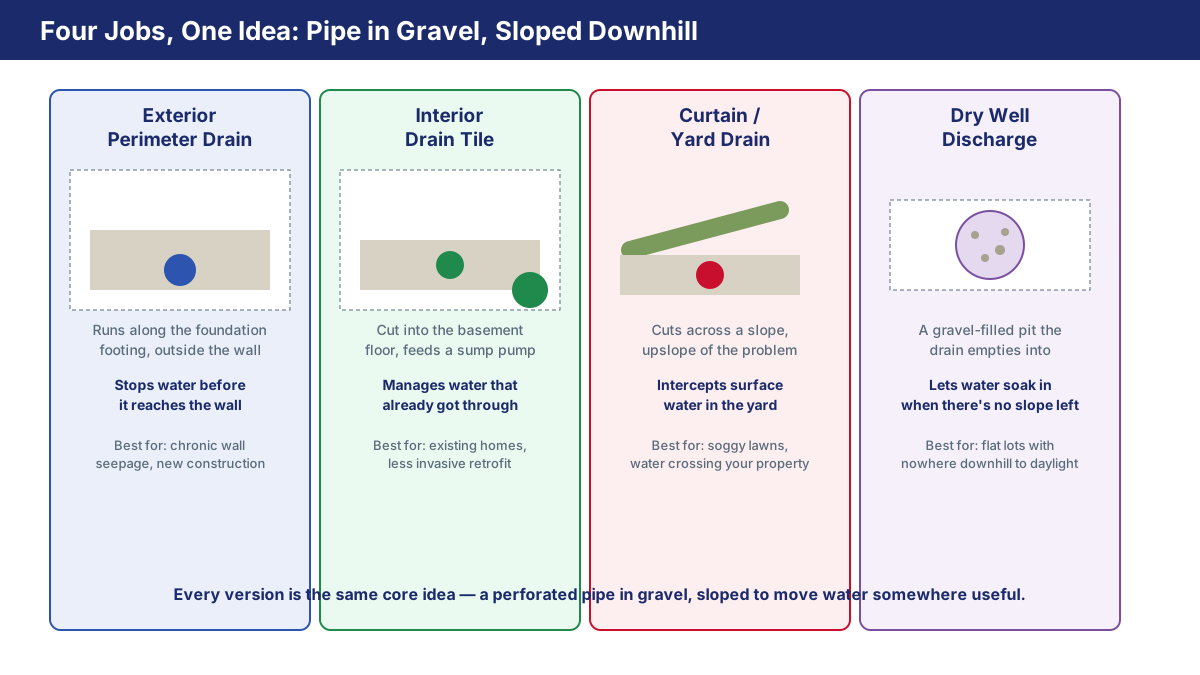
This is the part that actually causes the confusion, because a homeowner researching "French drain" often finds information about a completely different application than the one they need. In my review of contractor case files, it comes up in four distinct contexts:
- Exterior foundation perimeter drain. Installed at or near the footing, outside the basement wall, usually alongside a waterproof membrane during new construction or a major exterior waterproofing project. This version stops water before it ever reaches the wall.
- Interior drain tile. Cut into the basement floor around the interior perimeter and tied into a sump pump. Contractors often still call this a "French drain" even though it's doing a different job — managing water that has already gotten through the wall, rather than stopping it outside.
- Curtain drain (yard drain). Installed across a slope, upstream of the area you're protecting, to intercept surface water and shallow groundwater moving downhill before it ever reaches the house or a soggy section of lawn. This is the version most homeowners can reasonably DIY.
- Discharge into a dry well. On a flat lot with nowhere downhill to send the water, the pipe can empty into a gravel-filled pit (a dry well) that lets the water soak into the surrounding soil gradually instead of daylighting somewhere visible.
If you're dealing with a wet basement specifically, rather than a soggy yard, I'd start with how to waterproof a basement to figure out which of these applications (if any) your situation actually calls for before you commit to a specific fix.
How It's Different From a Sump Pump
This is the comparison I get asked about most, and the distinction is really about passive versus active. A French drain is entirely passive — gravity does all the work, there's no electricity involved, and there's nothing to fail except a clog or an original slope mistake. A sump pump is active: it collects water in a pit and mechanically ejects it, which is necessary whenever gravity alone can't move the water far enough or high enough on its own, such as getting water that's already on a basement floor back up and out of the house.
The two are frequently paired rather than competing: interior drain tile is a French drain that collects seepage and gravity-feeds it into a sump pit, where the pump takes over for the final push outside. I walk through exactly how that combination works, alongside exterior membranes and vapor barriers, in how basement waterproofing works.
How It's Different From a Curtain Drain
Strictly speaking, a curtain drain is a type of French drain, not a separate technology — same pipe, same gravel, same slope. The difference is purely about placement and purpose. A curtain drain is installed across a slope, upstream of whatever you're trying to protect, specifically to intercept water moving downhill through the yard before it reaches a problem area. A foundation perimeter drain, by contrast, runs directly along the house. In practice, contractors use "curtain drain" when talking about yard drainage and reach for "French drain" or "footing drain" when talking about foundation work, but you're looking at the same three ingredients either way.
How It's Different From a Dry Well
A dry well is a destination, not a drainage line. It's typically a gravel-filled pit (or a perforated plastic chamber surrounded by gravel) that a French drain, a downspout, or a curtain drain can empty into when there's no practical downhill point to daylight the water. Water enters the dry well and gradually percolates into the surrounding soil instead of flowing somewhere visible. You'll often see the two used together: a French drain moves the water, a dry well is where it ends up when gravity alone can't carry it any further off the property.
Materials That Actually Make Up a French Drain
- Perforated pipe — typically 4-inch PVC or corrugated pipe, ideally pre-wrapped in a filter sock.
- Clean, washed drainage gravel — free of dust and fine particles, which is what lets water move through it quickly.
- Non-woven landscape fabric — lines the trench to keep fine soil out of the gravel and pipe without blocking water flow.
- A discharge point — daylighting downhill away from the house, a dry well, or a sump pit, depending on the application.
The fabric is the piece people skip most often when trying to save money, and it's also the single biggest predictor of whether a French drain is still working in ten years or has quietly clogged with silt.
How Long One Actually Lasts
Because there's no motor and nothing mechanical to wear out, a properly built French drain with clean gravel and real filter fabric commonly lasts 20 to 30 years or more. The thing that eventually ends its useful life almost always isn't age — it's silt working its way into the gravel over decades and slowing the flow rate, which is exactly what the fabric liner is designed to prevent in the first place. I go into the physical reason that happens in how a French drain actually works, and how to tell whether a slow-draining trench can be cleaned or needs to be rebuilt in how to clean a French drain.
What This Costs in Virginia
A standalone exterior French drain typically runs $2,000 to $6,500 professionally installed, depending on the length of the run and how much excavation is involved. As a rough DIY materials estimate for a straightforward yard drain — pipe, fabric, and gravel, not counting your own labor — homeowners commonly budget somewhere around $5 to $15 per linear foot. Those are planning numbers, not a quote for your specific property; the only way to get an accurate price is an on-site look, which you can request free through our job request form.
Signs You Might Actually Need One
- Standing water in a specific section of yard for hours or days after rain
- A basement wall that's damp or seeping specifically after heavy rain, not constantly
- Water visibly running toward your house across the yard during a storm
- A neighbor's runoff crossing onto your property at a low point
- A downspout that already gets extended but the ground still stays saturated nearby
If what you're actually seeing is water on the basement floor itself, or a wall that's damp even in dry weather, that points more toward an interior drain tile and sump pump setup than a simple yard drain — worth reading how to waterproof a basement to make sure you're diagnosing the right problem before you dig anything.
When I'd Call a Professional Instead of DIYing It
A straightforward exterior yard drain on flat-to-moderate terrain is a reasonable weekend project for a patient homeowner — I cover the full step-by-step process, including the 811 utility-locate call you should never skip, in how to install a French drain, and a more project-plan-style walkthrough with a materials calculator and day-by-day schedule in how to build a French drain on your own. I'd hand it to a licensed contractor instead if you're dealing with a high water table, an interior drain tile system that requires breaking concrete, a tie-in to a municipal storm system (which can require a permit in some Virginia localities), or any sign the foundation itself is moving rather than just taking on surface water. You can compare licensed French drain installers near you on our map, or check contractor reviews before deciding who to call.
Conclusion
A French drain isn't one specific product — it's a simple, gravity-driven idea (pipe, gravel, slope) applied to at least four different jobs: keeping water away from a foundation, managing what gets through a basement wall, intercepting surface water in a yard, and giving water somewhere to go on a flat lot. Understanding which of those four situations you're actually in is most of the battle, because it determines whether you're looking at a weekend yard project or a job that belongs with a licensed waterproofing contractor. If you're not sure which one applies to your property, that's exactly the kind of question a free, no-obligation on-site estimate is built to answer.