
Knowing what a French drain is doesn't automatically explain why it works, and I think that gap matters more than people assume. I've watched otherwise careful DIYers get the trench, the pipe, and even the gravel right, then quietly skip the one detail that actually makes the whole system function — usually because nobody explained the mechanics, just the steps. If you already know what a French drain is and want the installation steps, I cover those in how to install a French drain. This article is about the "why" underneath those steps: the actual physical principles that make a trench full of gravel and pipe move water at all.
The Core Principle: Water Follows the Path of Least Resistance
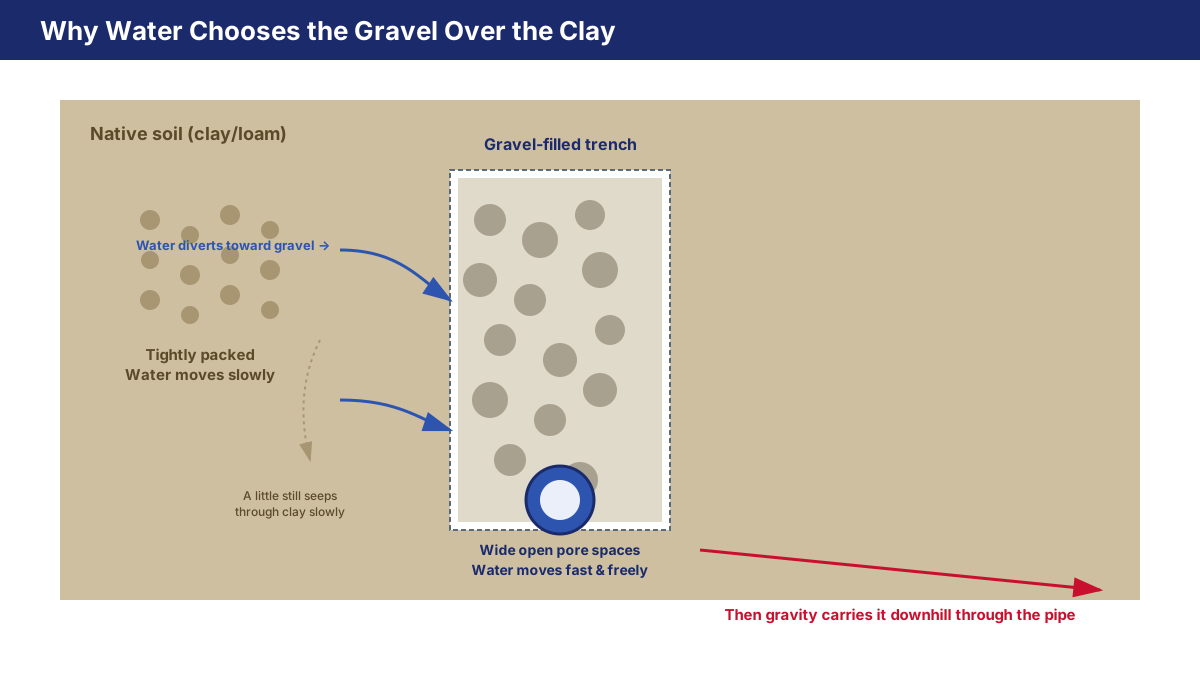
Water moving through soil behaves according to one simple rule — it moves toward wherever it encounters the least resistance. Resistance, in this context, comes down to how much open pore space a material has for water to travel through. Dense clay has very little open pore space between its particles; water has to squeeze through microscopic gaps, so it moves through clay slowly. Clean drainage gravel, by contrast, is mostly open space between the stones. Water moves through it easily and quickly, because there's so much less material in the way.
A French drain doesn't pull water toward itself with any force. It simply gives water an easier route than the surrounding soil, and water — always following the path of least resistance — naturally diverts toward that easier route once it's within reach of it. This is also exactly why the width of the gravel bed matters: a wider gravel envelope around the pipe intercepts water across more of the surrounding soil, not just the immediate area right next to the pipe itself.
Why the Pipe Needs Gravel Around It at All
A perforated pipe sitting directly in native soil, with no gravel around it, can only accept water at the exact points where soil happens to be in contact with a perforation. Everything in between those contact points is wasted opportunity. Surrounding the pipe with gravel changes that completely: now the entire width and depth of the gravel bed becomes the effective catchment area, because water that reaches any part of the gravel envelope can move freely through the open pore space until it finds a perforation. The gravel isn't packaging around the pipe — it's doing a large share of the actual hydraulic work.
Why Slope Isn't Optional
This is the detail I see skipped most often, and it's also the one with zero workaround. A French drain has no pump and no motor; gravity is the only force moving water through it. Without a continuous downhill slope from the high end of the trench to the discharge point, water that enters the pipe has no reason to keep moving — it will simply sit wherever the pipe happens to be level or, worse, pool in a low spot partway along the run. A trade rule of thumb that comes up constantly is a minimum of about 1/8 inch of drop per foot of run (roughly 1%), with more slope always being better on a gravity system, never a problem. I walk through checking that slope in practice, section by section, in how to install a French drain.
A trench that's perfectly built in every other respect but has one low sag in the middle will still hold standing water at that sag indefinitely, because gravity doesn't care how good the rest of the trench is — it only responds to the slope directly in front of the water at any given point.
Why the Filter Fabric Matters More Than It Looks Like It Should
Clean gravel works because of its open pore space, and that pore space is exactly what fine soil particles are small enough to migrate into over time. Without a fabric barrier, silt from the surrounding soil gradually washes into the gaps between the gravel stones every time water moves through, slowly filling in the exact open space the system depends on. A French drain doesn't fail suddenly when this happens — it fails gradually, draining a little slower each year until one day it's effectively not draining at all. Non-woven landscape fabric wrapped around the gravel envelope lets water pass through while physically blocking most of that fine sediment, which is the entire reason a properly built French drain can last 20 to 30 years while a poorly built one can clog within just a few seasons.
Which Way Should the Perforations Actually Face?
I want to be honest that this is one detail the trade doesn't fully agree on, rather than pretend there's a single universal answer. Most pipe manufacturers and installation guides recommend orienting the perforations downward, so water enters through the gravel and sock from below and any sediment that does get through has room to settle beneath the intake points rather than directly inside them. Some experienced contractors deliberately orient them upward instead, reasoning that it reduces the sediment that settles inside the pipe itself over time. Both approaches have a real logic behind them. My honest advice is to follow the specific instructions that came with your pipe rather than treating either direction as definitively correct.
How the Pipe, Gravel, and Slope Work Together as a System
Put the three principles together and the whole system makes sense as one continuous process. Water in the surrounding soil follows the path of least resistance into the gravel envelope. The gravel's open pore space lets that water move freely until it reaches a perforation in the pipe. The pipe collects it and, because the trench maintains a continuous downhill slope, gravity carries it along the pipe toward the discharge point without any mechanical assistance. The filter fabric wrapping the whole assembly is what keeps that pore space open years down the line instead of silting closed. Remove any one piece — the gravel, the slope, or the fabric — and the other two can't fully compensate for it.
Why It Eventually Needs Maintenance (or Doesn't)
Because there's no motor or mechanical part to wear out, a well-built French drain has a genuinely long service life — commonly 20 to 30 years or more. What actually ends that lifespan almost always comes back to the two mechanical principles above: either fine silt has worked its way past or around the fabric and gradually closed off the gravel's pore space, or the original slope had a weak point that's been collecting sediment in one spot for years. Neither of those is really "wear" in the way a pump motor wears out — they're both consequences of how the system was built in the first place, which is exactly why getting the fabric and the slope right during installation matters so much more than any material you choose afterward.
What This Means If You're Comparing Contractor Quotes
Once you understand the mechanics, evaluating a quote gets a lot more concrete. Ask what gravel size and cleanliness they're using (dusty, poorly washed gravel has less usable pore space from day one), whether they're wrapping the pipe, the gravel, or both in filter fabric, and how they're planning to confirm the slope across the whole run rather than just at the two ends. Those three answers tell you more about whether a French drain will still be working in fifteen years than almost anything else in the estimate. You can compare licensed French drain installers in our directory, or read contractor reviews before deciding who to call.
Conclusion
A French drain works because of three things acting together: gravel that gives water an easier path than the surrounding soil, a continuous downhill slope that lets gravity do all the work with no pump required, and filter fabric that keeps the gravel's open pore space from silting closed over the years. None of the three is optional, and none of them can compensate for a mistake in either of the others. Understanding that is what separates a French drain that quietly does its job for three decades from one that stops draining within a couple of seasons and gets blamed on "bad luck" instead of a slope or fabric mistake made on day one. If you'd rather have someone who builds these for a living confirm your specific site works with the physics rather than against it, that estimate is free and comes with no obligation.